
Leadership visibility
Exploring how leadership can gain a clearer view of digital trust dependencies and institutional exposure.
Research in progress
A conceptual model for understanding where digital trust is created, expressed, tested and governed across systems and dependencies.
A public draft being tested and refined through research, practical work and observation. It is not a finished standard or assurance model.
The Trust Surface Framework begins with a simple observation: institutional trust increasingly depends on systems and dependencies that extend far beyond traditional technology boundaries.
Domains, email infrastructure, identity systems, cloud platforms, communications channels, and third-party services all produce signals that influence whether organisations appear reliable, authentic, and well governed.
Most organisations manage parts of this landscape competently. Very few govern it as a coherent whole.
The framework explores a way to see that whole more clearly: identifying trust-critical systems, weak ownership, silent failure points and the places where technical reality must be translated into accountable judgement.
It is one research strand within my broader practice. The concepts are being tested against operating public work, organisational experience and further research rather than treated as settled doctrine.
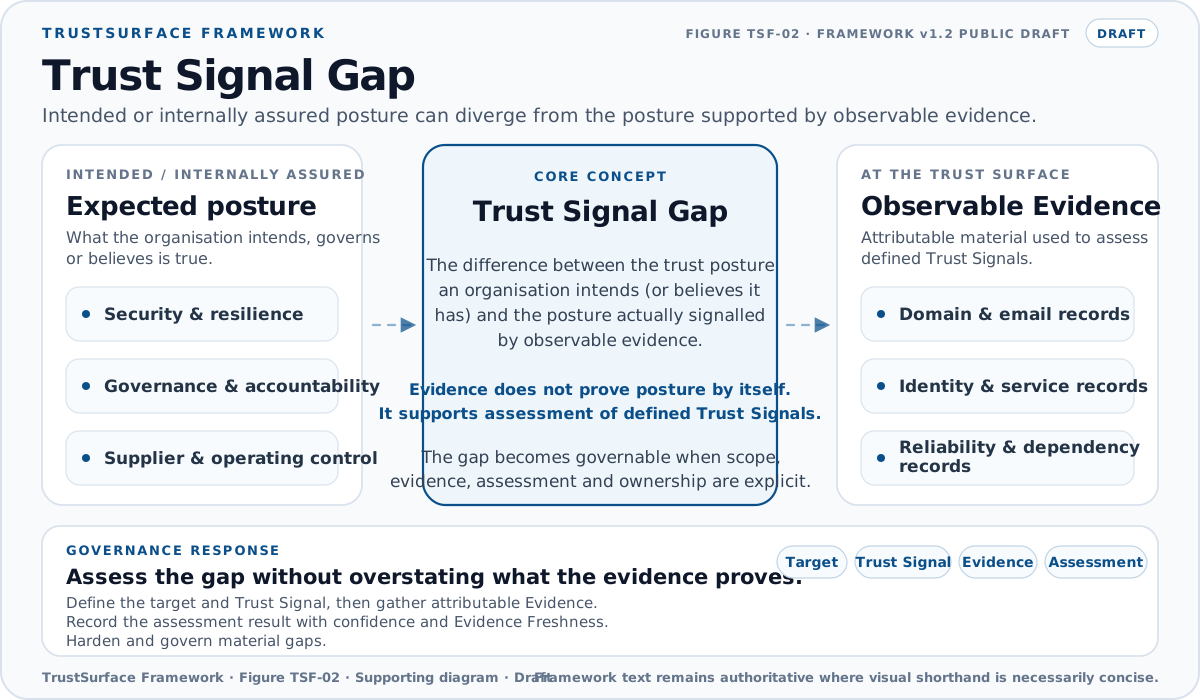
TrustSurface is deliberately being developed in the open. The current work is intended to sharpen concepts, terminology and governance questions through evidence and use, not to imply that a complete framework has already been validated.
ThreatScope Check, the .au Domain Observatory, the Domain Governance Baseline and related writing provide different places to test parts of the thinking. They remain independent pieces of work rather than implementations that prove the framework by definition.
Exploring how leadership can gain a clearer view of digital trust dependencies and institutional exposure.
Testing ways to improve governance visibility across fragmented estates, suppliers, and technical boundaries.
Clarifying accountability for trust-critical systems and the dependencies that shape public trust.
Supporting stronger board and executive questions before failure becomes visible in public.
Read the current framework on trustsurface.org

The Trust Surface concept treats digital trust as an observable property of the systems and dependencies organisations operate.
Trust is not created by policy statements alone. It is signalled continuously through the behaviour of infrastructure, identity systems, communications channels, and the external services organisations rely upon.
Understanding the Trust Surface means identifying where those signals originate, how they relate, and whether they are actually governed as a whole.