
Fragmented ownership
Important technology and supplier dependencies exist, but responsibility for them is distributed or unclear.
Practice
My work focuses on making complex technology environments legible enough for accountable people to decide, govern and deliver with confidence.
The work starts with the problem and the evidence. The Trust Practice is the discipline underneath it, not a product or assurance claim.
Where the practice applies
The most consequential technology issues are rarely isolated to one control or one platform. They cross operating models, suppliers, accountabilities, delivery pressure and the evidence available to decision-makers.
This practice is most useful where an organisation needs to understand what is actually happening before deciding what to build, change or govern differently.
Important technology and supplier dependencies exist, but responsibility for them is distributed or unclear.
Technical findings are understood by specialists but are not translating into accountable executive decisions.
Forums and controls exist, but they are weakly connected to what systems and dependencies are actually doing.
Urgency is driving work faster than sustainable ownership, support and operating capability can keep up.
People are discussing the same technology problem from different assumptions, evidence bases and definitions of consequence.
How I work
A repeatable discipline for moving from uncertain signals to evidence, decisions and sustained action.
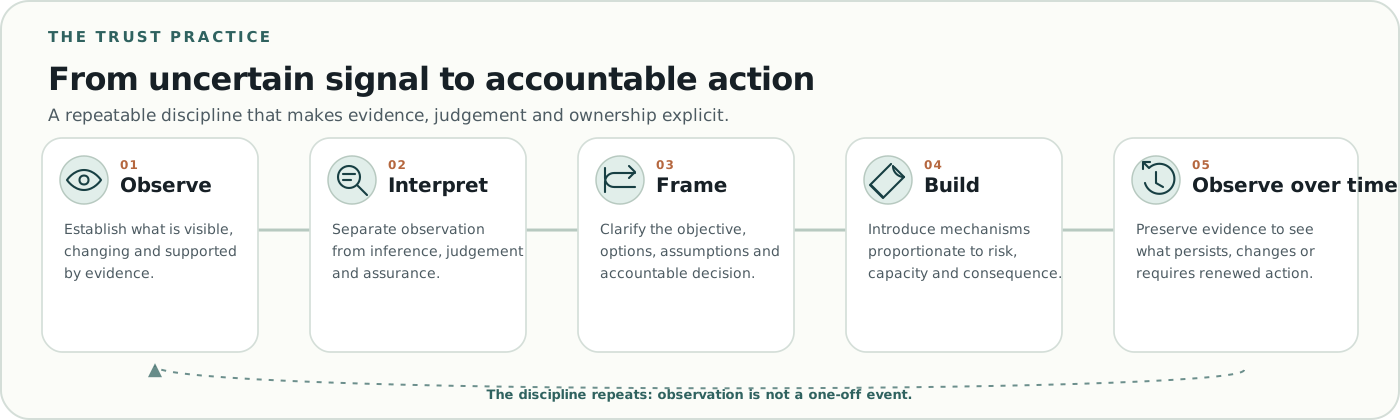
Establish what is visible, what is changing and what can be supported by evidence.
Separate factual observation from inference, judgement and unsupported assurance.
Clarify the objective, assumptions, options, dependencies and accountable decision-maker.
Introduce mechanisms suited to the actual risk, organisational capacity and public consequence.
Preserve enough evidence to distinguish routine change from persistent or governance-relevant patterns.
Across each step, the discipline is the same: observe before judging, avoid overstating assurance, make assumptions explicit and preserve accountable ownership.
Proof in operation
These projects are useful in their own right. They also show how I work with evidence, uncertainty, governance and sustained delivery over time.

Digital trust triage in practice
A public instrument for inspecting visible domain trust signals, supported by governed provider evidence and a private R&D environment for testing new approaches.
Demonstrates: evidence design · technical governance · product thinking · applied R&D

Independent longitudinal observation
An independent public-interest observatory studying visible domain, DNS, registration and email signals across a fixed .au panel over time.
Demonstrates: longitudinal research · data governance · methodology · evidence communication
Their value here is that the work, evidence and operating discipline are inspectable.
Supporting and emerging work
Practical governance guidance
A versioned governance instrument for making uncertainty around domain ownership, renewal, DNS, email authority, monitoring and accountability visible.
Research in progress
An emerging conceptual framework for understanding where digital trust is created, exposed, weakened and governed across systems and dependencies.
It remains intentionally exploratory while the concepts are tested against practical work, observation and further research.
Professional application
The recurring concerns are the same across technology leadership, governance and delivery: make the situation legible, preserve the evidence, clarify ownership and frame decisions proportionately.
Clarifying priorities, accountabilities, operating models and delivery where technology has become fragmented or difficult to govern.
Making dependencies, ownership, controls and uncertainty visible enough for executives and accountable owners to act.
Turning complex technical evidence into proportionate decisions, governance and practical next actions.
These independent projects sit alongside my full-time technology leadership work. This site is a portfolio of the ideas, systems and approaches I have developed across organisational, consulting and public-interest settings.